Clover patches spreading across your lawn? You’re not alone: white clover is the most common broadleaf weed in American lawns.
The good news: clover is one of the easiest weeds to kill, and there are both chemical and natural ways to do it.
Here’s exactly what kills clover and why it keeps coming back.
This post contains affiliate links. As an Amazon Associate, I earn from qualifying purchases at no additional cost to you.
Characteristics of Clover
Weed Status:
White clover (Trifolium repens) is a low-growing perennial broadleaf weed that’s a nuisance in lawns for most homeowners, but a sign of a bigger problem.
Unlike dandelions, clover doesn’t invade healthy lawns; it shows up where grass is struggling, usually from low nitrogen or mowing too short.
Growth Habit:
Clover spreads two ways: by seeds and by creeping stolons (above-ground runners) that root at every node. This is why hand-pulling alone rarely works, a broken runner regrows quickly.
Clover is also a nitrogen-fixer: it pulls nitrogen from the air, which is exactly why it thrives in lawns that haven’t been fertilized.
Appearance:
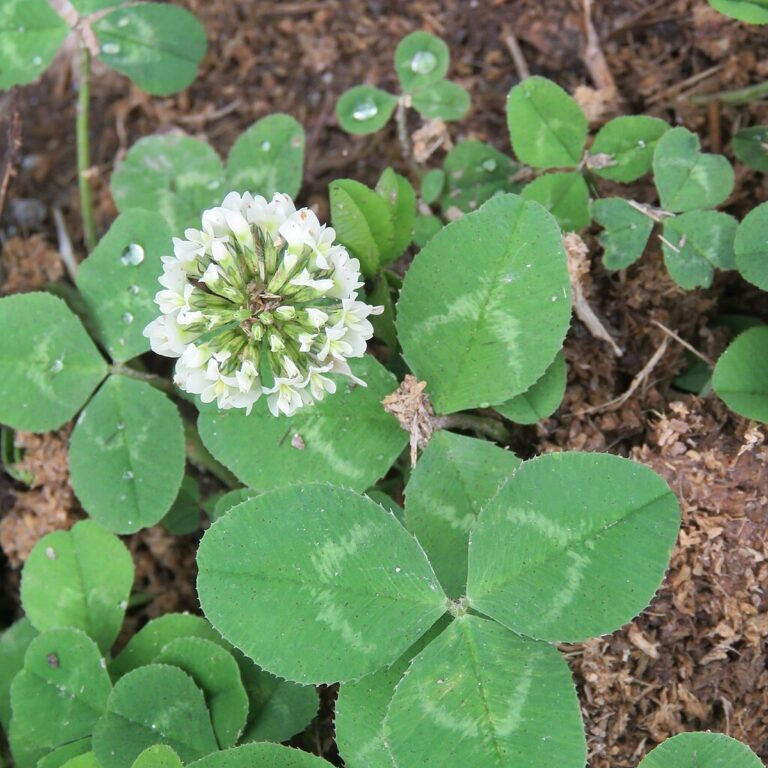
Three oval leaflets (occasionally four — the lucky find) with a lighter V-shaped mark on each leaf, and small white or pink ball-shaped flowers in summer. It grows flat, 2–8 inches tall, and tolerates heavy foot traffic better than most grasses.
Climate Suitability:
Clover is a cool-season plant that handles heat and cold both well, which is why it appears in nearly every climate zone in the U.S. It’s drought-tolerant once established and greens up early in spring and stays green late into fall.
Soil Preference:
Clover prefers soil low in nitrogen, that’s its secret weapon. It grows in compacted, poor, slightly acidic to neutral soils where grass struggles. If your lawn is full of clover, your soil is telling you something: it needs nitrogen.
Best Herbicide for Clover:
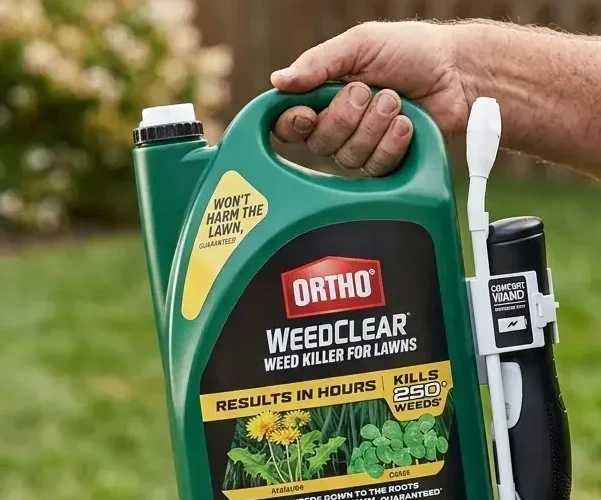
Ortho WeedClear (2,4-D + Dicamba + MCPP)
Mode of Action:
Selective broadleaf herbicides containing 2,4-D, dicamba, and MCPP are absorbed through clover’s leaves and move systemically to the roots and stolons. This is critical, clover’s creeping runners mean a contact-only spray just singes the top growth. A systemic herbicide kills the whole plant, runners included.
Effectiveness:
This combination is the industry standard for clover and is safe for most lawn grasses (Bermuda, fescue, Kentucky bluegrass, ryegrass). Expect visible wilting within 7–14 days. Clover is tougher than dandelions — a second application after 3–4 weeks is often needed for heavy patches.
Best Use:
Apply in spring or early fall when clover is actively growing (60–85°F), on a dry, windless day. Spot-treat patches, or treat the whole lawn if clover is widespread. Don’t mow for 2 days before and 2 days after application — the leaves need to absorb the herbicide.
Tips for Using a Clover Herbicide:
- Add a few drops of dish soap (or a non-ionic surfactant) to the sprayer — it helps the herbicide stick to clover’s waxy leaves.
- Water the lawn 24 hours before spraying so clover leaves are hydrated and open.
- Skip the weed-and-feed combo if you’re also applying nitrogen — fix the soil first, then spot-treat.
- Combine with cultural control (below) so clover doesn’t reestablish from seed.
How to Kill Clover Naturally (Without Chemicals)
1. Feed Your Lawn Nitrogen (The #1 Natural Fix)
Clover thrives in nitrogen-poor soil: that’s its evolutionary niche. A balanced nitrogen fertilizer (or leaving grass clippings on the lawn) makes the grass outcompete clover. This doesn’t kill existing clover overnight, but within one season the clover thins dramatically.
2. Vinegar + Dish Soap Spot Spray
Household vinegar (5% acetic acid) with a drop of dish soap burns clover foliage on contact. It won’t kill the stolons, so expect regrowth and reapply every 3–5 days. Be careful: vinegar is non-selective and will burn grass too — spray clover leaves only, on a sunny day.
3. Corn Gluten Meal (Pre-Emergent)
Apply 20 lbs per 1,000 sq ft in early spring to stop clover seeds from germinating. It won’t kill existing clover, but combined with nitrogen feeding it breaks the cycle.
4. Hand Removal Done Right
After rain (soft soil), use a forked weeder to lift the entire root crown, then rake out the stolons. Bag everything — every runner fragment can reroot. Overseed bare spots immediately so grass, not clover, fills the gap.
Why Is My Lawn Full of Clover?
Clover doesn’t cause a bad lawn, a bad lawn causes clover. The three most common reasons:
- Low nitrogen — grass starves, clover fixes its own food.
- Mowing too short — scalped grass weakens; clover loves low cutting.
- Thin grass — bare patches are open real estate for clover seeds.
Prevention: Keeping Clover Gone
- Mow at 3–4 inches. Taller grass shades clover seedlings.
- Fertilize with nitrogen in spring and fall.
- Overseed bare spots every fall.
- Keep clippings on the lawn — free nitrogen.
F.A.Q
What kills clover but not grass?
Selective broadleaf herbicides with 2,4-D, dicamba, and MCPP kill clover while leaving lawn grasses unharmed. Naturally, nitrogen fertilizer and mowing at 3–4 inches let grass outcompete clover without any chemical.
Does vinegar kill clover?
Yes, on contact. Vinegar burns clover leaves, but it doesn’t reach the stolons, so it regrows. Use it as a spot treatment with repeat applications every few days, and keep it off the grass.
Is clover bad for your lawn?
Not necessarily. Clover adds nitrogen and feeds bees. It only becomes a problem when it takes over. If you want a uniform grass lawn, treat the underlying cause (low nitrogen, short mowing, thin turf) rather than just spraying.
Will clover die in winter?
White clover is a perennial it goes dormant in winter and returns in spring. Only a systemic herbicide applied while it’s actively growing kills it permanently.