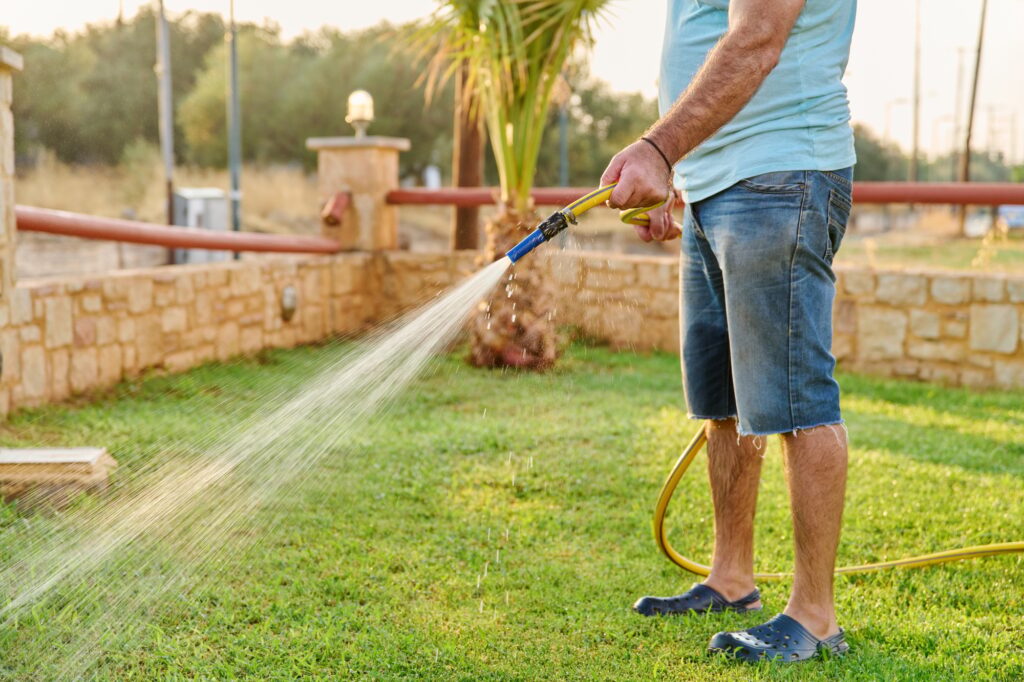
Summer is here, and with it comes the annual challenge of keeping your lawn lush and green.
As temperatures soar and rainfall becomes unpredictable, knowing how long to water your lawn and when is the best time to water your lawn in summer can mean the difference between a vibrant yard and a crispy, brown patchwork.
Whether you’re a first-time homeowner or a seasoned gardener, this ultimate summer lawn watering guide will walk you through everything you need to know—from evaporation rates and ideal timing to a downloadable watering duration chart and heatwave survival strategies.
This post contains affiliate links. As an Amazon Associate, I earn from qualifying purchases at no additional cost to you.
When Is the Best Time to Water Your Lawn in Summer?
If there’s one question that dominates summer lawn care discussions, it’s: when is the best time to water your lawn in summer? The answer is unanimous among turfgrass experts: early morning.
The ideal window is between 4 a.m. and 10 a.m. , with many specialists recommending the sweet spot of 5 a.m. to 9 a.m. Watering during these hours offers several critical advantages:
- Minimal evaporation — the sun is low, temperatures are cool, and wind speeds are typically calm
- Better water distribution due to lower wind speeds and good water pressure
- Leaves dry before nightfall, reducing the risk of fungal diseases
- Water penetrates deeper into the soil before the heat of the day accelerates evaporation
What About Evening Watering?
While watering in the early evening is better than midday, it comes with risks. Nighttime watering keeps grass blades wet for extended periods, creating a humid microclimate that invites fungal diseases.
If you must water in the evening, aim for 4 p.m. to 6 p.m. so the grass has time to dry before nightfall.
The Midday Mistake
Watering during the heat of the day—between 10 a.m. and 4 p.m. —is the least efficient time to water your lawn. Evapotranspiration rates peak during these hours, meaning your grass and the soil are losing moisture faster than at any other time.
Estimates show that daytime irrigation can lose 20% to 30% of water to evaporation, and in some cases, up to 50% can evaporate before it ever reaches the roots. Even more startling: irrigating at midday can waste 40% to 60% of applied water.
Bottom line: To water grass efficiently, set your sprinklers to run in the early morning hours. Your lawn—and your water bill—will thank you.
Understanding Evaporation Rates and Water Loss
To truly master summer lawn watering, you need to understand evaporation rates—the invisible thief that steals water before it reaches your grass’s roots.
What Is Evapotranspiration?
Evapotranspiration (ET) is the combination of two processes:
- Evaporation — water lost from soil and plant surfaces
- Transpiration — water lost through the plant itself
Evapotranspiration is greatest during the hottest hours of the day—typically 10:00 a.m. to 4:00 p.m. .
During summer heatwaves, ET rates can reach as high as 0.3 inches per day—that’s over 2 inches of water loss per week from your lawn.
How Much Water Do You Actually Lose?
| Time of Day | Estimated Water Loss to Evaporation |
|---|---|
| Midday (10 a.m. – 4 p.m.) | 20% – 60% |
| Early Morning (4 a.m. – 10 a.m.) | Minimal (best efficiency) |
| Night | ~15% (but higher disease risk) |
The math is simple: water grass in the morning and you keep more of that water where it belongs—in the soil, feeding your lawn’s root system.
How Long to Water Your Lawn: Duration by Soil and Grass Type
Now for the million-dollar question: how long to water your lawn? The answer depends on two primary factors: soil type and grass type.
The “1-Inch Rule”
As a general guideline, most turfgrasses require approximately 1 inch of water per week—whether from rainfall or supplemental irrigation—to sustain growth during warmer conditions. During heatwaves, this increases to 1.5 to 2 inches per week.
Soil Type Matters Most
Different soils absorb and retain water differently, which directly affects how long to water your lawn in each session:
| Soil Type | Characteristics | Watering Frequency | Duration Per Session |
|---|---|---|---|
| Sandy Soil | Drains quickly, low water retention | 2–3 times per week | 20–40 minutes |
| Loamy Soil | Balanced drainage and retention | 2 times per week | 20–30 minutes |
| Clay Soil | Retains water, slow absorption | 1–2 times per week | 15–25 minutes |
Why the difference? Sandy soil drains quickly, requiring longer watering sessions to ensure water reaches the root zone.
Clay soil, on the other hand, absorbs water slowly—water too fast and you’ll get runoff rather than absorption.
Loamy soil offers the best of both worlds, with balanced water retention and drainage.
Grass Type Considerations
Your grass type also influences how long to water your lawn:
- Cool-season grasses (tall fescue, Kentucky bluegrass, perennial ryegrass): Require approximately 1 inch of water per week to maintain active growth during drought stress. They are less efficient water users than warm-season varieties.
- Warm-season grasses (Bermudagrass, Zoysiagrass, St. Augustinegrass): Much more efficient water users and do not require as much supplemental irrigation during hot, dry conditions.
The “Deep and Infrequent” Principle
Perhaps the most important rule in summer lawn watering is deep and infrequent watering.
Instead of watering a little bit every day—which encourages shallow roots that dry out quickly—water deeply and less often.
Why this works:
- Deep watering encourages roots to grow downward, chasing moisture
- Deeper roots mean better drought tolerance and heat resistance
- Infrequent watering allows soil to dry between sessions, preventing disease
As Virginia Tech turfgrass expert Dan Sandor explains: “Watering established, mature lawns a little bit every day is not a practical approach as it enables water to remain at or near the soil surface, leaving it more prone to evaporative loss”.
How to Know If You’re Watering Enough
Here’s a simple test: Push a screwdriver into your lawn after watering. If it easily sinks 6 to 7 inches deep, your watering duration is just right. If it’s difficult to push in, you need to water longer.
Another telltale sign: footprints that linger after walking across your lawn indicate the grass blades lack the moisture to spring back—a clear sign it’s time to water grass.
Summer Heatwave Survival Guide
When extreme heat hits, your lawn needs special attention. Here are actionable tips to keep your grass alive and thriving during summer heatwaves:
1. Increase Watering Amount, Not Frequency
During a heatwave, increase your weekly watering from 1 inch to 1.5–2 inches. But don’t water more often—stick to deep, infrequent sessions. Applying 0.25 to 0.50 inches per irrigation event allows water to penetrate deep into the soil profile.
2. Consider a “Cycle and Soak” Approach
For clay soils or sloped lawns, water in cycles: run your sprinklers for 15–20 minutes, wait 1–2 hours for water to absorb, then run another cycle. This prevents runoff and ensures water reaches the root zone.
3. Raise Your Mower Blade
Set your mower height to 3 inches or higher during summer. Taller grass:
- Shades the soil, reducing evaporation
- Keeps roots cooler
- Promotes deeper root growth
Follow the “1/3rd rule” : never remove more than one-third of the grass blade in a single mowing.
4. Skip Summer Fertilizing
Do not fertilize cool-season grasses during peak summer heat. Fertilizing stresses the plant and promotes disease. Save fertilization for early fall.
5. Let It Go Dormant (If You Choose)
If you decide not to water, your lawn will go dormant—a natural survival mechanism. The grass will turn brown but isn’t dead. During dormancy:
- Do not mow the lawn
- Minimize all traffic on the lawn
- Apply ¼ to ½ inch of water every 2–3 weeks to keep the crown alive
6. Monitor for Signs of Heat Stress
Watch for:
When you see these signs, it’s time to water.
Watering Duration Chart
Use this quick-reference chart to determine how long to water your lawn based on your soil type and grass variety:
| Soil Type | Weekly Frequency | Minutes Per Session | Weekly Total |
|---|---|---|---|
| Sandy | 3 times | 25–35 min | 75–105 min |
| Loamy | 2 times | 25–30 min | 50–60 min |
| Clay | 1–2 times | 15–25 min | 15–50 min |
Adjust based on rainfall, temperature, and grass type. Warm-season grasses may need less; cool-season grasses may need the higher end of the range.
How to Calibrate Your Sprinkler System
To know exactly how long to water your lawn with your specific system:
- Place 5–6 straight-sided containers (tuna cans work well) across your lawn
- Run your sprinklers for 15 minutes
- Measure the water depth in each container with a ruler
- Calculate the average depth
- To deliver 1 inch of water: Divide 1 inch by your average depth, then multiply by 15 minutes
For example: If your cans collect ¼ inch in 15 minutes, you need to run your sprinklers for 60 minutes total per week to deliver 1 inch of water.
Common Summer Watering Mistakes to Avoid
Final Thoughts
Mastering summer lawn watering doesn’t have to be complicated. Remember the three pillars of a healthy summer lawn:
- Water early — between 4 a.m. and 10 a.m. for maximum efficiency
- Water deeply — 1 inch per week, delivered in long, infrequent sessions
- Water wisely — adjust duration based on your soil type, and increase during heatwaves
Following this guide, and you’ll know exactly when is the best time to water your lawn in summer and how long to water your lawn to keep it green, healthy, and resilient—even during the hottest days of the year.