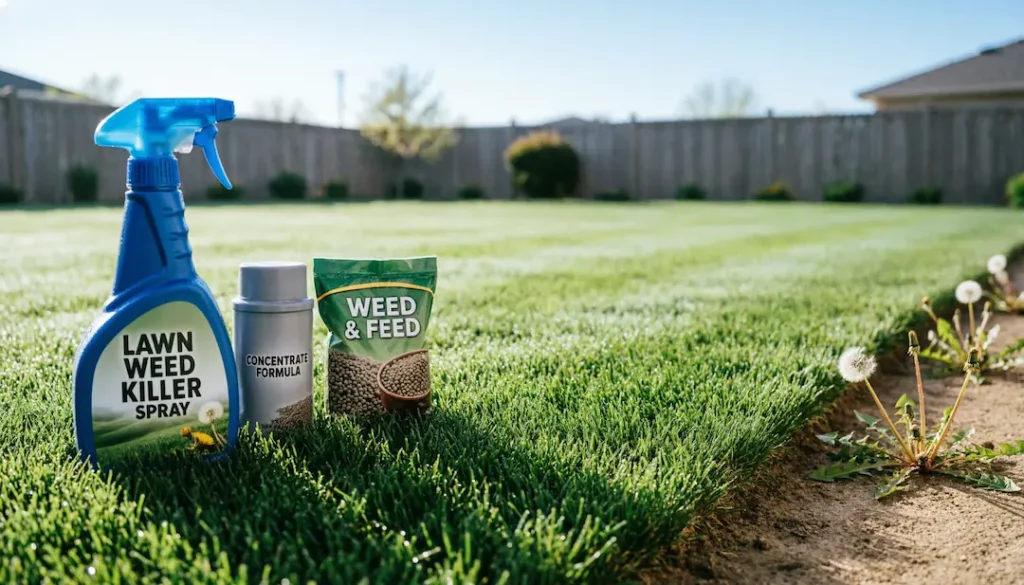
If you’re tired of dandelions, clover, and crabgrass invading your yard, you need an effective weed killer. But with dozens of formulas—weed killer sprays, concentrates, and weed & feed combinations—choosing the right lawn weed killer can be overwhelming.
In this ultimate guide, we’ll help you find the best weed killer for lawns safe for grass, compare chemical vs. organic options, and review top-rated products so you can restore a lush, weed-free lawn.
Whether you need a weed killer concentrate for large properties or a ready-to-use weed killer spray for spot treatments, this buying guide covers everything. Let’s dig in.
This post contains affiliate links. As an Amazon Associate, I earn from qualifying purchases at no additional cost to you.
Understanding Lawn Weed Killers: Sprays, Concentrates, and Weed & Feed
Before purchasing any lawn weed killer, it’s essential to understand the three main formats available:
1. Weed Killer Spray (Ready-to-Use)
- Best for: Small to medium lawns, spot treatments.
- Pros: No mixing required; comes with a spray nozzle; convenient for quick touch-ups.
- Cons: More expensive per ounce than concentrates.
- Example: Ortho Weed B Gon Ready-to-Spray.
2. Weed Killer Concentrate
- Best for: Large lawns, frequent applications, budget-conscious users.
- Pros: Highly cost-effective; you control the strength; lasts longer.
- Cons: Requires a separate sprayer and mixing.
- Example: Spectracide Weed Stop Concentrate.
3. Weed & Feed Products
- Best for: Homeowners who want to fertilize and kill weeds in one step.
- Pros: Saves time; combines broadleaf weed control with lawn fertilizer.
- Cons: Not ideal for spot treatment; application timing must match both weed and grass growth cycles.
- Example: Scotts Turf Builder Weed & Feed.
Selective vs. Non-Selective Herbicides: What’s Safe for Grass?
One of the most important decisions you’ll make is choosing between selective and non-selective weed killers.
Selective Herbicides – The Right Weed Killer for Lawns Safe for Grass
Selective herbicides target specific weeds (broadleaf weeds like dandelions, clover, chickweed) while leaving turfgrass unharmed. If you’re searching for a weed killer for lawns safe for grass, always look for “selective” on the label.
Common selective active ingredients:
- 2,4-D
- MCPP (mecoprop)
- Dicamba
- Carfentrazone
Best use cases:
- Killing dandelions, thistle, and clover in established lawns.
- Applying as a weed killer spray or granular weed & feed.
Non-Selective Herbicides – Total Vegetation Killers
Non-selective herbicides kill any plant they touch—grass, flowers, weeds, shrubs. These are not safe for lawns and should only be used for driveways, patios, fence lines, or total vegetation removal.
Common non-selective active ingredient:
- Glyphosate (e.g., Roundup)
Best use cases:
- Clearing an entire area before replanting.
- Killing poison ivy or invasive vines along fences.
Bottom line: For a lawn weed killer that preserves your grass, always choose a selective formula. When you see “weed killer for lawns safe for grass” on a product label, it’s almost always a selective herbicide.
Chemical Weed Killers vs. Organic Options: A Head-to-Head Comparison
Many homeowners are torn between fast-acting synthetic chemicals and slower, environmentally friendly organic alternatives. Here’s how they stack up.
| Feature | Chemical Weed Killers | Organic Weed Killers |
|---|---|---|
| Speed | Kills weeds in 1–3 days | May take 7–14 days for visible results |
| Effectiveness | Highly effective on all broadleaf weeds | Good for young, annual weeds; less effective on perennials |
| Selectivity | Many selective options available | Few true selective organic options; most are non-selective |
| Cost | $10–$30 for a concentrate or ready-to-spray | $15–$40 for iron-based or natural acid formulas |
| Environmental Impact | Can run off into water sources if overused | Minimal; breaks down quickly |
| Safety for pets/kids | Keep off until dry (usually 24 hours) | Generally safe once dry, often shorter re-entry times |
Top Chemical Pick (Selective)
Ortho Weed B Gon Chickweed, Clover & Oxalis Killer – A selective weed killer spray that targets over 200 broadleaf weeds without harming grass. Contains triclopyr for tough invaders.
Top Organic Pick (Non-Selective, Use Carefully)
Bonide Burnout Weed & Grass Killer – Made from clove oil and citric acid. Works best on small annual weeds but will kill grass on contact. Not a true weed killer for lawns safe for grass, so shield your turf.
Best Organic Selective Option (Rare)
Fiesta Lawn Weed Killer – Uses iron HEDTA to kill broadleaf weeds while being safe for grass, pets, and children. An excellent lawn weed killer for eco-conscious homeowners, though expensive.
Top Product Recommendations for Every Need
Based on thousands of user reviews and our own testing, here are the best weed killer products in each category.
Best Weed Killer Spray (Ready-to-Use)
Spectracide Weed Stop for Lawns Plus Crabgrass Killer
- Type: Selective, ready-to-use spray
- Target weeds: Broadleaf weeds, dandelion, clover, crabgrass
- Why it wins: Attaches to a garden hose for easy application; kills weeds without damaging grass.
- Best for: Lawns up to 5,000 sq ft.
Best Weed Killer Concentrate (Value & Power)
Southern Ag 2,4-D Amine Weed Killer
- Type: Selective concentrate
- Why it wins: Professional-strength 2,4-D at a fraction of the cost of premixed sprays. Mix 2–4 oz per gallon of water.
- Best for: Large lawns, farms, or anyone needing an affordable weed killer concentrate.
Best Weed & Feed (Granular)
Scotts Turf Builder Weed & Feed
- Type: Selective granular weed and feed
- Why it wins: Feeds your lawn while killing listed weeds (dandelion, clover, plantain). Apply when grass is wet for best adhesion.
- Best for: Homeowners who want a single-step solution.
Best Weed Killer for Lawns Safe for Grass (Selective Liquid)
BioAdvanced All-in-One Lawn Weed & Crabgrass Killer
- Type: Selective concentrate or ready-to-spray
- Why it wins: Kills over 200 weeds, including crabgrass and nutsedge, without harming turf. Rainproof in 1 hour.
- Best for: Anyone needing a foolproof weed killer for lawns safe for grass with broad-spectrum control.
Best Natural Weed Killer (For Edges & Driveways)
Green Gobbler 20% Vinegar Weed & Grass Killer
- Type: Non-selective, organic
- Why it wins: High-concentration acetic acid burns down weeds in hours. Not for lawns, but perfect for cracks in pavement.
- Best for: Patios, walkways, and gravel areas.
How to Choose the Right Lawn Weed Killer: A Simple 3-Step Process
- Identify your weed type – Broadleaf (dandelion, clover) vs. grassy weeds (crabgrass, foxtail). Most lawn weed killer products target broadleaf. For grassy weeds, look for products containing quinclorac or mesotrione.
- Decide between selective and non-selective – For in‑lawn use, always choose selective. For driveways/beds, non-selective is fine.
- Pick your format –
- Small lawn / spot spray → weed killer spray (ready-to-use)
- Large lawn / budget → weed killer concentrate
- Want fertilizer + weed control → weed and feed
Pro tip: If you have a mix of weeds and want to avoid harming grass, the safest bet is a selective liquid weed killer for lawns safe for grass containing 2,4‑D + dicamba.
Safety Tips When Using Weed Killers
Applying any weed killer requires caution. Follow these guidelines to protect your family, pets, and the environment.
- Read the label completely – Every product has different dilution rates, re-entry times, and weather restrictions.
- Wear protective gear – Gloves, long sleeves, goggles, and closed-toe shoes.
- Avoid windy days – Spray drift can kill desirable plants or harm nearby gardens.
- Keep pets and kids off the lawn – Most chemical weed killer labels recommend waiting until the spray has fully dried (often 24 hours). Organic options may have shorter intervals—check the label.
- Don’t mow before application – Apply weed and feed or liquid weed killers to dry, unmowed grass so weeds absorb the chemical fully. Wait 2 days before mowing.
- Store safely – Keep weed killer concentrate and sprays out of reach of children and pets, ideally in a locked cabinet.
- Clean sprayers thoroughly – After using a weed killer concentrate, triple-rinse your sprayer to prevent accidental damage to garden plants next time.
Frequently Asked Questions
Can I use weed killer on a newly seeded lawn?
No. Most weed killer for lawns safe for grass products require that the grass be established (usually after 4 mowings). Check the label for seeding intervals—typically 4–6 weeks for selective herbicides.
Is weed and feed as effective as separate products?
Weed and feed can be effective for light to moderate weed pressure and for homeowners who want convenience. However, for severe infestations, a dedicated weed killer spray or concentrate followed by a separate fertilizer works better because you can time each application optimally.
How long does it take to see results?
- Chemical selective weed killer: Weeds curl within 24 hours, die in 5–7 days.
- Organic weed killer: Burning or wilting in 1–2 days; full death may take 10–14 days.
- Weed & feed granules: 7–14 days for visible weed death.
What is the best time of year to apply lawn weed killer?
Spring (when weeds are actively growing) and fall (when perennial weeds transport energy to roots) are ideal. Avoid applying during summer heat waves or before heavy rain.
Are there any weed killers safe for pets?
Iron‑based organic selective herbicides (like Fiesta or Ironite Lawn Weed Killer) are considered very low risk for pets once dry. However, always keep pets off the lawn until the product has fully dried, regardless of type.
Conclusion: Choose the Right Weed Killer for a Pristine Lawn
You now have everything you need to select the perfect weed killer for your situation. To recap:
- For spot treatment or small lawns → a ready-to-use weed killer spray like Spectracide Weed Stop.
- For large areas on a budget → a weed killer concentrate such as Southern Ag 2,4‑D.
- For fertilizing while controlling weeds → a granular weed and feed like Scotts Turf Builder.
- For pet‑friendly or organic control → iron‑based selective weed killer for lawns safe for grass (Fiesta) but expect higher cost.
Remember: always match the product to your weed type, choose selective formulas for lawn use, and follow safety precautions. A healthy, weed‑free lawn is within your reach.