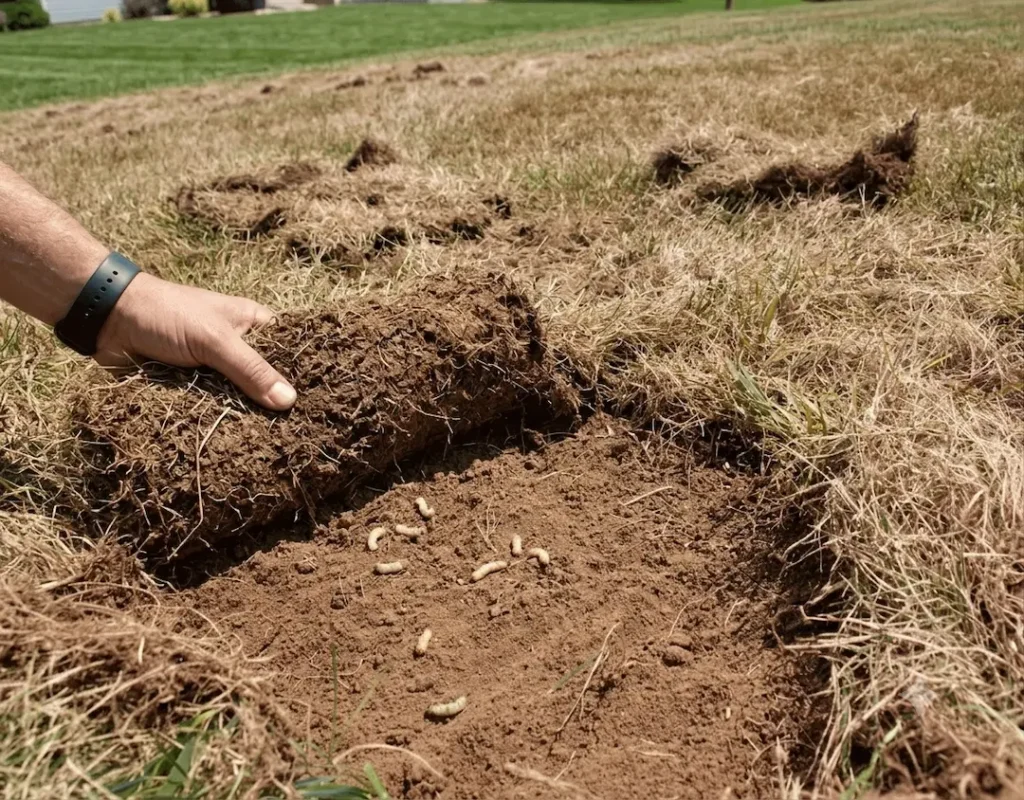
One morning you step outside and notice patches of your lawn feel spongy underfoot. A week later, those patches are dead and peeling back like carpet.
That’s the signature of lawn grubs — and by the time you see the damage, they’ve been feeding on your grass roots for weeks.
I’ve dealt with grub damage in my own lawn and helped countless neighbors recover theirs. Here’s how to spot them early and stop them before they destroy your turf.
This post contains affiliate links. As an Amazon Associate, I earn from qualifying purchases at no additional cost to you.
What Are Lawn Grubs?
Lawn grubs are the larval stage of several beetle species — most commonly Japanese beetles, June bugs, and European chafers. They live in the soil and feed on grass roots.
A healthy lawn can tolerate a few grubs (5–10 per square foot). But when populations climb above that, the root damage becomes severe enough to kill patches of grass.
Signs of Grubs in Your Lawn
| Sign | What to look for |
|---|---|
| Spongy turf | Grass feels like thick carpet — roots are severed |
| Irregular brown patches | Brown spots that grow over time, especially in late summer |
| Grass pulls up easily | Like peeling back sod — no roots holding it down |
| Animals digging | Skunks, raccoons, crows, or armadillos tearing up the lawn at night |
| Wilted grass despite water | Roots are damaged, so the grass can’t take up moisture |
The most distinctive sign: if you can roll back a patch of dead grass like a rug, you have grubs. That means the roots have been eaten clean off.
How to Check for Grubs (The Tug Test)
- Cut a 1-square-foot section of grass on three sides (leave one side attached)
- Fold it back like a flap
- Count the white grubs in the top 2 inches of soil
- Do this in several spots around the damaged area
Thresholds:
- 0–5 grubs per sq ft: Normal — no treatment needed
- 6–10 per sq ft: Moderate — treat if lawn is stressed or thin
- 10+ per sq ft: Severe — treatment recommended
Late summer and early fall (August through September) is the best time to check, because that’s when young grubs are actively feeding near the surface.
What Do Lawn Grubs Look Like?
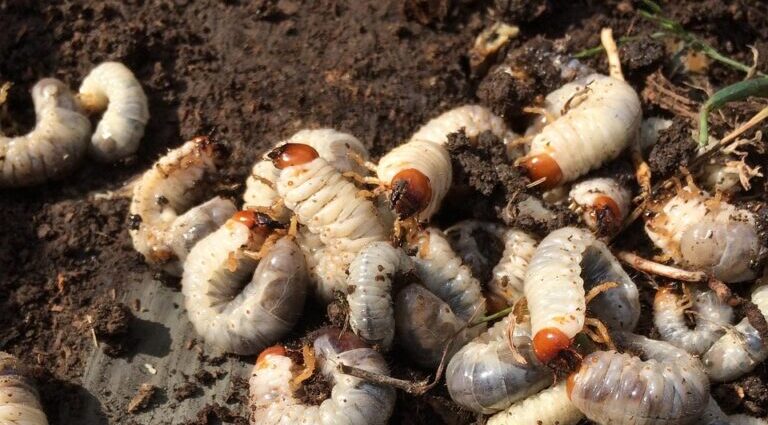
Grubs are easy to identify once you see them:
- C-shaped — curled into a crescent
- White or cream-colored — with a dark spot at the rear (the gut contents showing through)
- Three pairs of legs — small brown legs near the head
- Size — 1/4 to 1 inch long (varies by species and age)
- Head — small brown or orange capsule
If you see them, the legs give them away as grubs vs. other soil insects. The C-shape and white body are the telltale signs.
Life Cycle of a Grub
Understanding the life cycle is key to timing your treatment:
| Stage | Timing | What’s happening |
|---|---|---|
| Eggs | June–July | Adult beetles lay eggs in moist soil |
| Young grubs (1st instar) | July–August | Tiny grubs hatch and feed near surface |
| Mature grubs | August–October | Active feeding — most damage happens now |
| Deep soil | October–March | Grubs burrow down 4–8 inches to overwinter |
| Pupation | April–May | Grubs transform into adult beetles |
| Adults emerge | May–July | Beetles emerge, mate, lay eggs — cycle repeats |
Best treatment window: Late July through August, when grubs are small and feeding near the surface. Treatments applied after mid-October are mostly wasted because grubs have moved deep into the soil.
How to Get Rid of Grubs
You have two main approaches: natural/biological or chemical. Natural methods take longer but spare beneficial insects. Chemical treatments act faster.
Natural Grub Control Options
Beneficial Nematodes
Tiny microscopic worms that seek out and infect grubs. They enter the grub’s body and release bacteria that kill it within 24–48 hours.
- Best for: Active grub infestations
- When to apply: Late summer (August), when grubs are small and soil temperature is above 60°F
- How to apply: Mix with water and spray on moist soil in the evening (nematodes are UV-sensitive)
- Cost: $15–$30 for enough to treat 2,000–4,000 sq ft
Nematodes are the most effective natural option and work well for most home lawns.
Milky Spore
A bacterium (Paenibacillus popilliae) that specifically targets Japanese beetle grubs. Once established in soil, it can last 10–15 years.
- Best for: Long-term prevention in lawns with recurring Japanese beetle problems
- When to apply: Spring or fall
- Limitation: Only works on Japanese beetles — won’t help with June bug or chafer grubs
- Setup time: Takes 1–3 years to build up in soil
Encourage Natural Predators
Birds, moles, and beneficial insects all eat grubs. You can:
- Leave some areas of your lawn undisturbed for ground beetles
- Install a bird bath to attract birds
- Avoid broad-spectrum insecticides that kill beneficial predators
Chemical Grub Treatments
| Product type | Active ingredient | Best for | When to apply |
|---|---|---|---|
| Preventive | Imidacloprid or clothianidin | Stopping grubs before they hatch | June–July |
| Curative | Dylox (trichlorfon) | Active infestations (fast-acting) | August–September |
| Dual-action | Chlorantraniliprole | Prevention + early control | Spring or early summer |
Important: Preventive products must be applied before eggs hatch. If you already see damage in late summer, you need a curative product like Dylox, which kills grubs within 24–48 hours.
Always water in chemical grub treatments with at least 1/2 inch of water immediately after application.
Repairing Grub Damage
After the grubs are gone, the dead patches won’t come back on their own — the roots are destroyed.
- Remove dead grass — rake out the dead sod
- Loosen soil — rake or aerate the top 1/2 inch
- Add compost or topsoil — a thin layer (1/4 inch)
- Seed — use a grass type that matches your lawn
- Water — keep moist for 2–3 weeks
Fall is the best time for repair — the same conditions that help grass germinate also help your lawn recover before winter.
Conclusion
The key to grub control is catching them early. Check your lawn in late summer with the tug test. If you find more than 5 per square foot, treat with nematodes or a targeted insecticide. Your lawn will thank you by staying green and rooted.
F.A.Q
Will grubs kill my lawn?
Yes, if populations exceed 10+ per square foot. The roots are completely severed, and the grass dies. A light grub population (under 5 per sq ft) won’t cause visible damage.
Are grubs and earthworms the same thing?
No. Earthworms are beneficial — they aerate soil and create nutrients. Grubs are beetle larvae that eat roots and damage grass. Earthworms are reddish-pink and long; grubs are white, C-shaped, and have legs.
Do moles eat grubs?
Yes — moles love grubs. If you see mole tunnels in your lawn, grubs are likely on the menu. But eliminating grubs won’t always make moles leave (they also eat earthworms).
Can grubs come back every year?
If you have Japanese beetles or other scarab beetles in your area, they will lay eggs in your lawn each summer. Preventive treatment in June/July breaks the cycle.
What’s the best time to treat for grubs?
Late July through August. That’s when newly hatched grubs are small, feeding near the surface, and easiest to kill. Treatments after October are largely wasted.
Milky spore vs. nematodes — which is better?
Milky spore lasts longer (10+ years) but only targets Japanese beetles. Nematodes work on all grub species but need to be reapplied annually. For most lawns, nematodes are more practical.